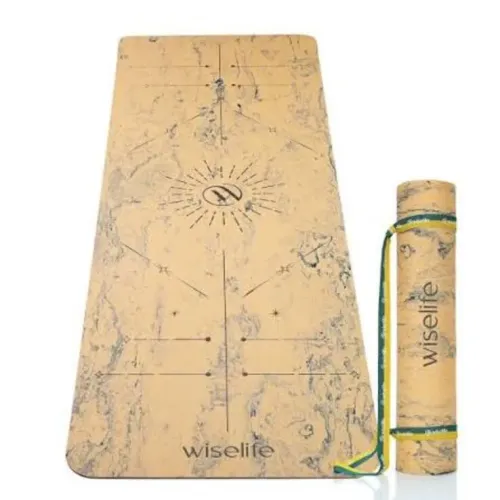
An EVA label tells you very little about how a mat will behave under sweaty hands, a planted foot, a kneeling joint or repeated burpees. By the end, you will know which material and construction details to compare, how to test a mat before buying, and when EVA is a sensible choice—or a poor substitute for a denser yoga or impact surface.
Key takeaways
- Compare density, hardness and surface finish—not EVA alone.
- Choose softer cushioning for kneeling and firmer support for balance work.
- Test grip, curling and compression before buying for regular workouts.
- Match mat thickness and underside texture to your floor and cleaning routine.
What EVA Tells You—and What It Leaves Out
An EVA yoga mat is not defined by the word EVA alone. EVA foam is a material family whose vinyl-acetate content, foam density, hardness, cell structure and surface finish affect comfort and control. Two mats can share the same label yet respond very differently under a knee, palm or dumbbell.
| Feature | More comfortable and stable result | Common failure |
|---|---|---|
| Foam density and hardness | Resilient cushioning that supports weight without excessive compression | Low-density or very soft foam bottoms out under knees, elbows or loads |
| Surface texture | Embossing or a traction-oriented skin that resists hand and foot movement | A smooth surface becomes slippery during downward dog or sweaty transitions |
| Underside construction | Contact that stays secure on the actual floor | Dust, polished tile or perspiration lets the whole mat slide |
| Closed-cell foam | Lower liquid uptake and easier wipe-downs | Assuming “EVA” guarantees closed-cell construction |
Before buying, ask for:
- Foam density and hardness, because density alone does not predict comfort and hardness alone does not prove durability.
- Thickness, compression-set data and a defined slip or traction test.
- Confirmation that the mat uses closed-cell foam, plus details of any laminated, embossed or perforated surface skin.
Test the complete mat on your floor, not only the top face. A mat that feels cushioned during kneeling can still feel unstable during lunges, balance poses or bodyweight strength work. Closed-cell foam improves wipeability, but textured faces and edges still hold sweat and dirt; repeated cleaning must not make the surface tacky or damaged.
Match Cushioning and Stability to the Movement
Choose EVA mat thickness according to the movement, not by treating extra cushioning as automatically better. A thinner, firmer mat gives more stability for standing poses, downward dog and single-leg balance; a thicker, softer mat relieves knees, wrists and the spine on hard floors but can make transitions and loaded positions wobble.
| Movement | Thickness and firmness priority | Reason |
|---|---|---|
| Yoga standing and balance | Lower thickness with firm, resilient foam | Preserves proprioception and reduces foot movement during single-leg poses |
| Strength work and lunges | Medium thickness with high bottoming-out resistance | Supports knees and elbows without letting hands, feet or weights sink unpredictably |
| Floor exercises and mobility | Greater cushioning with controlled firmness | Improves comfort for kneeling, seated work, rolling and spinal exercises |
| Jumping, burpees and repeated impact | Use a dedicated impact-rated floor or landing surface | A yoga mat’s cushioning does not prove impact protection for joints or flooring |
For strength work, compare density and hardness together. Low-density foam can bottom out under a knee, elbow or dumbbell, while excessive hardness removes the comfort you wanted.
Ask for compression set data tested under ISO 1856, then check whether the mat recovers after realistic loading; a permanent bench or rack depression undermines both cushioning and stability.
Also match the choice to the floor. A soft, thick mat over polished tile can slide or buckle during lateral movements even when its top feels grippy, so test the complete mat under loaded transitions.
For HIIT with repeated impact, use EVA only as part of a suitable impact surface rather than as a substitute for one.
Test Grip, Curling and Durability Before You Buy
A dry-hand demo proves little: an EVA mat can feel secure in a shop and turn slick under sweaty hands. Test the complete mat on the floor you use, including downward dog, lunges, kneeling and side-to-side transitions.
| Test | How to perform it | Warning sign |
|---|---|---|
| Surface grip | Press both palms and bare feet down, then hold downward dog for 30 seconds and step into a lunge. | Hands or feet creep, or you must grip with your toes. |
| Underside grip | On tile or polished wood, repeat a slow lateral step and a loaded transition from plank to kneeling. | The mat shifts even though the top feels secure. |
| Edge curling | Unroll the mat flat for 24 hours, then walk across each edge and corner. | Edge curling, lifted corners or a rolled end that will not settle. |
| Compression recovery | Hold a knee, elbow and dumbbell on one spot for 60 seconds; inspect it after five minutes. | A permanent dent, bottoming out or a visibly thinner patch. |
- Compare the EVA mat grip after the surface is damp, not only when clean and dry.
- Ask for thickness, density or hardness, and compression-set data; the word EVA alone does not predict resilience.
- Reject a sample that tears when stretched lightly, sheds surface particles, or develops cracks after repeated folding.
- Test several mats from the same batch before a bulk purchase, because uneven foam or backing can make one roll behave differently from another.
Choose the Right Surface for Your Floor and Routine
An EVA mat for tile floors works well for yoga, mobility and home workouts because it softens a hard, cold surface. Test the underside, not only the top: dust, polished tile, sweat and lateral movement can make the complete mat slide.
| Surface or routine | EVA mat fit | Choose another surface when |
|---|---|---|
| Tile | Good for floor-based yoga, lunges and bodyweight work | The mat shifts during loaded transitions or side steps |
| Carpet | Useful for added cushioning on short-pile carpet | Thick carpet makes the mat bunch, rock or feel unstable |
| Outdoor use | Suitable for brief sessions on clean, dry, level ground | Sun, moisture, rough concrete or stones could damage the foam or reduce grip |
| Shared studio | Practical if each user can clean and dry it between sessions | The venue needs a documented flammability classification or test report for the finished mat |
| HIIT, burpees and jumping | Acceptable for low-impact intervals on a suitable floor | Repeated impact needs an impact-rated exercise floor or landing surface |
For burpees and jumping, a yoga mat is not an impact system. EVA cushioning depends on thickness, density and resistance to bottoming out; a soft mat that compresses against tile will not protect joints like an impact-rated floor. Choose a separate exercise surface for high-impact programming.
Carpet and foam also reduce sensory feedback, so a thick EVA mat can make single-leg poses, squats and loaded exercises less controlled. Outdoor sessions demand a clean, dry underside, while prolonged indoor workouts need ventilation because foam retains heat.
Specify Care, Hygiene and Commercial-Use Requirements
Clean an EVA mat after each shared session with a soft cloth, lukewarm water and the manufacturer’s mild cleaning solution. Avoid bleach, oils, alcohol-heavy products, abrasive pads and untested disinfectants: unsuitable chemicals can harden, swell or weaken the foam. A cleaning EVA yoga mat routine should remove sweat without leaving a slippery residue.
- Wipe both faces, paying attention to textured grooves and the underside where dust collects.
- Air-dry it fully away from direct sun before rolling; trapped moisture encourages odour and surface deterioration.
- Roll it loosely with the exercise surface outward, then store it flat or upright in a cool, dry cupboard.
- Keep it away from radiators, windows, hot vehicles and prolonged ultraviolet exposure, which accelerate fading and mechanical ageing.
A new EVA mat can release a noticeable EVA mat odour. Odour alone does not prove danger, so commercial buyers should request a material declaration, destination-market chemical compliance evidence and an indoor-emissions or VOC test before placing mats in a studio, school or hotel.
Ask Eldorado One Stop Yoga Store for the finished mat’s thickness, density, cleaning instructions and batch details, then request a flammability classification and test report covering the complete construction, including printed film, adhesive and backing.
Test the dry and sweaty grip, underside sliding and cleaning process on the actual floor; a sports label does not make EVA an impact-rated floor or a building-compliant installation.
Frequently asked questions
What does EVA tell you about a yoga mat?
EVA identifies the foam material family, but it does not specify density, hardness, cell structure or surface finish. Those details determine cushioning, grip and stability.
How should you match an EVA mat to your workout?
Choose cushioning for kneeling, floor exercises and recovery work, but prioritise firmness and stability for balance poses, standing strength exercises and dumbbell training.
What should you test before buying an EVA yoga mat?
Check whether the surface stays grippy under dry and sweaty hands, whether the mat curls after unrolling, and whether it compresses permanently under your knees or equipment.
How do you choose an EVA mat for a floor and routine?
Match thickness and underside texture to the floor, then confirm that the mat can be cleaned with your routine and withstand repeated use in a home or commercial setting.