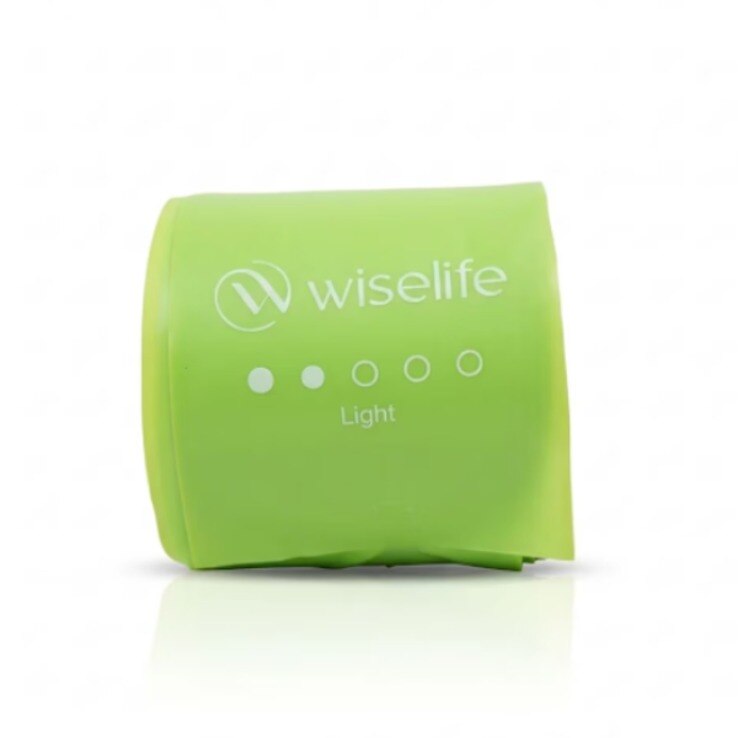
An exercise band does not act like a fixed-weight dumbbell: its force changes as you stretch it, and its direction changes when you move the anchor. By matching the band’s tension, starting length and setup to the movement, you can use it either to challenge a joint or muscle or to support a controlled range of motion.
Key takeaways
- Pre-stretch the band to add resistance from the first repetition.
- Expect tension to rise as the band lengthens through a movement.
- Choose bands by measured force at a stated stretch length, not colour.
- Anchor bands securely and inspect them for cuts before every session.
How band tension changes through a movement
An exercise band creates external resistance by storing elastic force as you stretch it. Band tension usually rises as the band lengthens, producing variable resistance: the final part of a movement feels heavier than the start. Starting length matters too. Pre-stretching raises force from repetition one; slack leaves the opening range almost unloaded at first.
The force direction decides whether the band resists or assists. Anchor it in front to oppose a row, or behind to assist the pull directly. For a squat, a band under your feet and over your shoulders resists standing; one fixed above can provide upward assistance.
It pulls along its line, not the movement you want.
Active resistance versus assistance is a programming choice, not a colour or band label. Pulling the band apart during a pass-through or moving away from an anchor makes your muscles control the load. Assistance can guide a joint, but it does not replace muscular control.
If alignment fails at peak tension, reduce stretch or change the anchor.
Using a band for stretching and mobility
Use the band as a guide, not a lever that drags you into range. Active resistance means you move against the band; assistance means the band supports part of your body or supplies a gentle directional pull.
These purposes are not interchangeable: an external pull can increase joint translation and end-range stress even when the surrounding muscle is relaxed.
For a band-assisted hamstring stretch, lie on your back, loop the band around your foot and hold both ends. Raise the leg with a slightly bent knee, using only enough tension to support the limb.
Keep your pelvis heavy on the floor; reduce the angle or band tension if your hip lifts, knee locks or the stretch becomes sharp.
A shoulder mobility pass-through needs generous hand spacing and almost no slack at the start. Move the band from in front of your thighs overhead and behind you, widening your grip when the shoulders pinch or the ribs flare. The band should reveal your available range, not force the arms through it.
For ankle mobility, anchor the band behind you and loop it across the front of the ankle. Keep your heel down while the knee travels toward the second toe; use a lighter pull if the foot rolls inward or the joint feels compressed.
During controlled joint circles, maintain slow, even tension and make the circle smaller when your alignment changes. Pre-stretching increases force throughout the movement, so excessive starting tension defeats the purpose.
Adding resistance to strength exercises
A band squat, glute bridge and lateral walk make rising resistance easy to feel: the loop stretches as you press the knees or legs outward.
A band row teaches a different lesson: with the anchor in front, tension is usually highest when your arms are extended and falls as you pull the handles toward your ribs.
| Exercise | How resistance changes | Alignment to control |
|---|---|---|
| band squat | A loop above the knees gains tension as you drive the knees outward during descent and ascent. | Keep knees tracking over the second and third toes; do not let the band pull them inward or force the feet to roll outward. |
| glute bridge | The loop challenges hip abduction as you lift and actively press the knees apart. | Keep the pelvis level and ribs down; stop pressing outward if your lower back arches or your feet supinate. |
| lateral walk | Each step away from the planted leg lengthens the band, increasing demand on the outer hip. | Use short steps with toes forward, a quiet pelvis and knees bent; do not lean the trunk to clear the band. |
| band row | With an anchor in front, the band is most stretched at arm’s length, so the load does not rise toward the squeeze. | Keep the spine still, shoulders away from the ears and elbows moving without shrugging. |
Choose a starting length that creates light tension before repetition one. Too much slack makes the opening range unproductive; excessive tension causes knee collapse, trunk leaning or shortened movement before the stronger part of the range.
Setting up and using a band safely
An anchor that holds for a pull toward a closed door can fail when you pull toward the opening side. Match the anchor method and direction of pull to the manufacturer’s instructions; never assume a heavy door, chair or table is secure because it feels stable.
- Perform a band inspection before every session. Run your fingers and eyes over the full working length and attachment area; reject the band for cuts, nicks, surface cracks, thinning, sticky patches or abrasion.
- Keep the band away from sharp edges, rough welds and hot surfaces. Heat, ultraviolet light and ozone accelerate deterioration, so store it cool, dry and out of direct sunlight.
- Anchor it at the intended height and test with a gradual load. Keep the attachment point in line with the pull; a side anchor adds twisting force and can drive a knee, shoulder or spine away from alignment.
- Remove slack before the first repetition, but do not stretch the band beyond its stated limit. Excess slack leaves the opening range almost unloaded, while excessive stretch increases failure risk.
- Hold handles with a closed grip and keep fingers clear of pinch points. Stop if the band rolls, slips, snaps toward you or changes position.
Use a safe stretching technique: move slowly, keep the joint tracking over the foot or hand, and use only mild tension without bouncing or forcing end range. For assisted mobility, position the band so it supports the limb rather than dragging it sideways; controlled joint circles should remain pain-free.
Choosing a band by force data, not colour
A “medium” or “heavy” label cannot tell you how a band will feel. Compare force-at-length data instead: ask for the force in newtons or pounds at specific elongations such as 25%, 50% and 100%, then match those figures to your exercise.
| Choice | What to compare | Best fit and trade-off |
|---|---|---|
| Length | Starting length and available stretch length | Longer bands suit pass-throughs and assisted mobility; excessive slack leaves the first part of a repetition almost unloaded |
| Width and thickness | Force at the same elongation, not width alone | Wider or thicker material often increases resistance, but only measured data confirms it |
| Flat band roll | Cut length, edge condition and anchor compatibility | Useful for custom lengths and mobility work; a poorly cut edge can roll or concentrate wear |
| Loop band versus tube with handles | Closed-loop tension versus handle grip and anchor hardware | Loops suit walks and bridges; tubes suit rows and presses but add hardware failure points |
Pre-stretch the band before judging its resistance. Moving farther from an anchor or starting with more tension raises force throughout the movement, while excessive stretch can exceed the stated limit. Elastic hysteresis also means loading and unloading forces differ, so do not treat the rating as an exact dumbbell equivalent.
When comparing a roll at Eldorado One Stop Yoga Store, ask for the measured test length, maximum intended stretch and inspection guidance, not just its colour. Reject any band with cuts, cracks, abrasion or a damaged attachment area.
Related product
 | Home Fitness HQ TPE Thera Band Roll - Green ₹2492 HQ TPE Thera Band Roll is designed for effective strength training, physical therapy, and full-body conditioning. View product → |
Frequently asked questions
Why does band tension change during a movement?
Elastic force usually increases as the band lengthens, so the final part of the movement feels heavier. Pre-stretching increases starting tension, while slack leaves the opening range lightly loaded.
How can you use a band for stretching and mobility?
Use the band to assist a limb into position or add controlled resistance, then move slowly without forcing the joint or allowing the band to snap back.
How does a band add resistance to strength exercises?
Attach or hold the band so it lengthens during the exercise, increasing external resistance through the range. Adjust starting length to control the load from the first repetition.
How do you use an exercise band safely?
Check the band for cuts, cracks and thinning; secure anchors; keep the band away from sharp edges; and maintain control instead of releasing stored tension suddenly.
How should you choose an exercise band?
Compare the force produced at a stated stretch length, such as 100% or 200% elongation. Do not rely on colour because colour codes vary between manufacturers.